All articles · · By Steve Lewis
Indoor Story Trail for Children: A Reading and Movement Activity
An indoor story trail turns a few pages and pictures into a small journey across the room. It can add movement to family reading without becoming a race or obstacle course. Build a short, safe route, invite your child to choose how to travel along it, and let the story guide the conversation.
What is an indoor story trail?
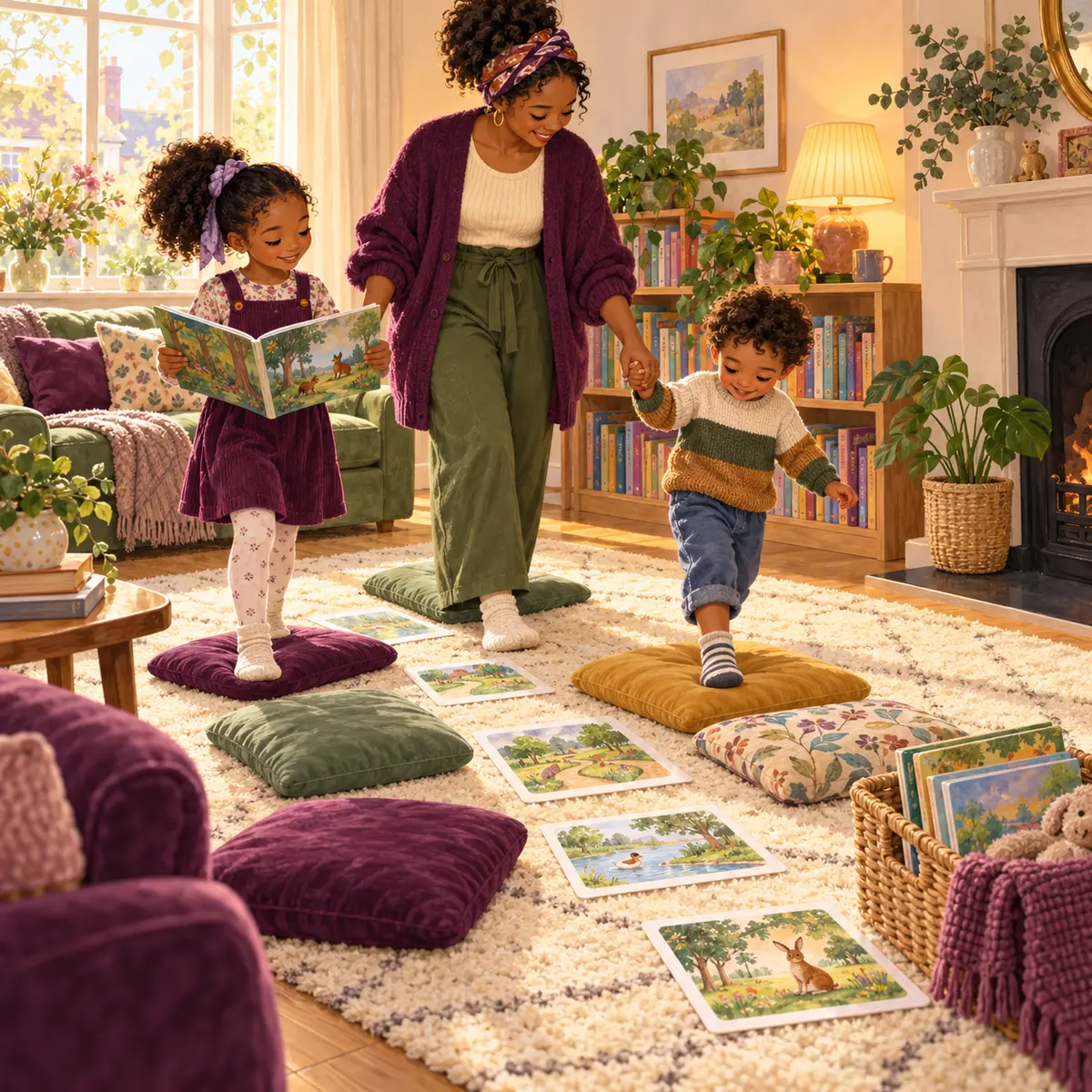
A story trail is a line of simple stopping places connected to a book. At each stop, you might look at a picture, remember what happened next or answer one gentle question. The child moves between the stops in a way that feels comfortable, while an adult stays close and shares the activity.
This version is designed for an ordinary room. It does not need special equipment, a large space or energetic movement. Three or four stops are enough for a first trail.
Gather a few safe materials
Choose a picture book, three or four sheets of paper and, if useful, a few flat non-slip cushions. Draw one simple picture on each sheet: a character, a place, an object or a feeling from the story. Your drawings only need to make sense to your family.
Use an uncluttered area away from stairs, doors, heaters and trailing cables. Keep every stop flat on the floor and remove anything that could slide, tip or invite climbing. An adult should check the route and supervise throughout.
Build a four-stop route
Place the pictures in story order with a comfortable amount of space between them. The first picture can show where the story begins, the middle pictures can show an important choice or problem, and the final picture can show what changed.
Invite your child to help decide the order. If two pictures could come next, compare them with the book rather than treating a mistake as a failure. Looking back at the page is part of reading.
Choose how to move—or stay in one place
Offer simple choices: walk, take a grown-up’s hand, point to the next card, move a toy along the route or sit while the adult brings each picture closer. Movement is optional. The activity still works when every card is placed on a table or tray.
Keep the pace slow enough for conversation. Do not ask a child to jump over objects, balance on raised furniture or continue when they are tired or uncomfortable.
Add one gentle prompt at each stop
Try prompts that invite noticing rather than test memory: “What can you see?”, “How might this person feel?”, “What could happen next?” and “Who could help?” A child can answer with words, a gesture, a drawing or by finding the page in the book.
You do not need to correct every detail while the child talks. If the answer changes the story completely, enjoy the new idea, then say, “Shall we look at what the book says happened?”
Practise asking for help
Add a pause where the child can choose a help phrase, such as “Please hold my hand,” “Can you show me?” or “I need a break.” Adults can model the phrase first. Responding calmly shows that asking for help is welcome.
Do not create a frightening problem for the child to solve. The purpose is to practise words and choices in a secure situation, not to see whether they can manage without support.
Connect the activity to Moses and the Path Through the Sea
Moses and the Path Through the Sea is a Little Bible Explorers digital eBook for shared reading with children aged 3–8. Its current book page describes a retelling about trust, freedom and asking for help, alongside a present-day scene in which Mum helps Eli choose a safe next step at a little bridge.
Read the book’s grown-up guidance before sharing it because the Bible account includes the deaths of the pursuing army, which the child-facing edition acknowledges without illustrating. The indoor trail in this article is an additional family activity, not a reproduction of the activities included in the eBook.
Finish while the activity still feels enjoyable
Let the final stop lead to a comfortable ending: put the book in a basket, choose a favourite picture or ask, “Which part shall we remember?” Then tidy the route together so the floor is clear.
For another day, change only one element—a different story, fewer stops or a toy travelling in the child’s place. Explore Moses and the Path Through the Sea for the current description and digital-edition details, and use our six story-time questions for more relaxed conversation ideas.