All articles · · By Steve Lewis
7 Simple Teamwork Activities for Children Aged 3–8
Teamwork is easier for children to understand when they can see it happening in small, familiar moments. These seven low-preparation activities help families explore sharing a job, noticing when someone needs support and asking before stepping in. They are designed for home, a reading group or a quiet afternoon together.
Begin with a story about caring help
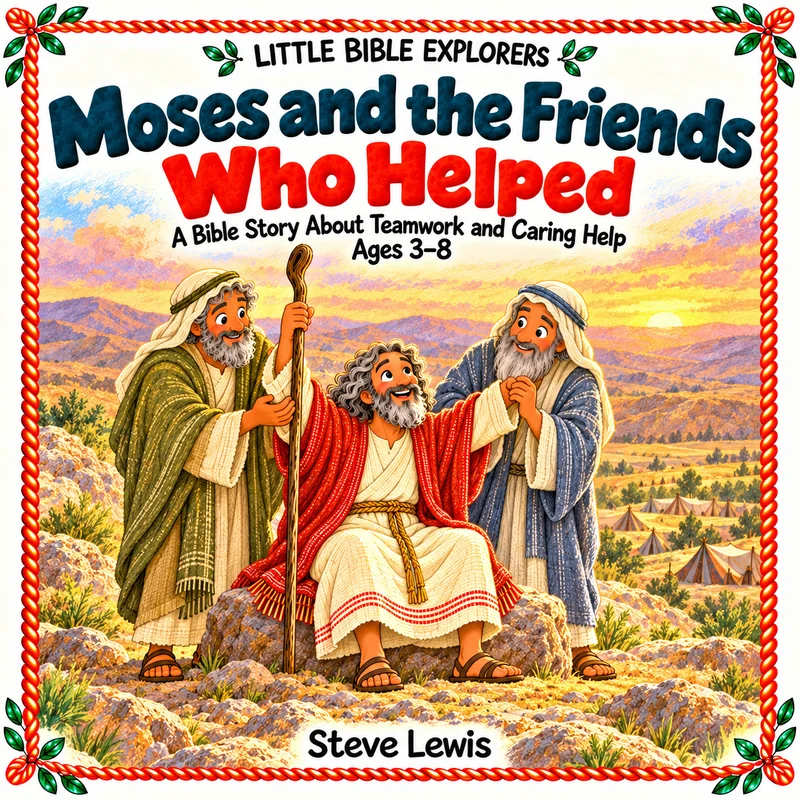
Moses and the Friends Who Helped is based on selected events from Exodus 17:8–16. It tells how Aaron and Hur support Moses when his hands grow heavy. The book acknowledges the battle in the passage without illustrating fighting. A separate modern family story shows Eli feeling overwhelmed by a pile of paper bookmarks while Maya offers help, Mum listens and the family shares the colouring before resting with their books.
Read at your child’s pace. You might pause to ask, “How did the friends notice help was needed?” or “What could someone say if they wanted help or a rest?” There is no need to turn the conversation into a test. The activities below are simple follow-on ideas rather than extracts from the book.
1. Make one picture together
Put one large sheet of paper in the middle and choose a simple scene, such as a garden, a picnic or a row of houses. Take turns adding one detail at a time. Before drawing, each person can say what they plan to add so that everyone has room.
For younger children, use chunky crayons and keep the picture open-ended. Older children may enjoy agreeing on a few shared details first. The aim is to make one picture that contains everyone’s ideas, not to decide whose drawing is best.
2. Share a tiny sorting job
Choose a safe, ordinary job with a clear finish: matching clean socks, sorting books by size or putting pencils into colour groups. Divide the job so each person has a manageable part, then bring the results together.
Keep it brief and stop if the task becomes frustrating. Afterwards, ask what made the job easier and whether anyone wanted a different part. This helps the conversation stay focused on the experience rather than on speed.
3. Practise “ask, listen, help”
Invent a small pretend problem: a toy box is too full, a tower keeps wobbling or someone cannot reach a pencil. One person asks for help, the second listens and then offers two choices, such as “Shall I hold the box or move some toys?” Swap roles after each turn.
Remind children that helping starts with listening. Sometimes the kind answer is to help; sometimes it is to give the person space or fetch a grown-up.
4. Build a two-person book trail
Choose three or four books and make a short trail from the shelf to your reading place. One person selects the next book while the other carries it, then swap. At the end, choose one book to read together and return the others as a team.
There is no need to race. A slow trail keeps the activity calm and makes the shared choices more important than finishing first.
5. Use a help-or-rest signal
Make two simple cards: one with an open hand for “help, please” and one with a cushion for “I need a rest”. Use them during a drawing, puzzle or tidy-up. Children can hold up a card when words are hard to find.
Treat both cards as acceptable choices. If a child asks for help, ask what kind would be useful. If they choose rest, agree when or whether to return to the task.
6. Plan a three-step family job
Pick one small job and draw three boxes for its steps. For example: gather the books, place them on the shelf, choose tomorrow’s story. Let each child choose a step, or work side by side if that feels better.
Children aged 3–5 may prefer pictures in the boxes. Children aged 6–8 can add short labels or suggest a fair way to share the work.
7. End with a teamwork thank-you
After any shared activity, invite each person to name one helpful thing they noticed: “You held the paper,” “You asked before moving my block,” or “You told us you needed a break.” Keep the thanks specific and optional.
If your family would like a story to continue the conversation, explore Moses and the Friends Who Helped. The digital edition is made for shared reading with ages 3–8 and includes discussion questions, a caring plan, a prayer and two book activities.