All articles · · By Steve Lewis
How to Talk to Children About Fairness and Speaking Up
Children often notice when something feels unfair, but they may not yet have the words to explain what happened or what they need. A calm story and a few practical prompts can help parents and carers make room for those conversations without expecting a child to solve every problem alone.
Begin with a story about being heard
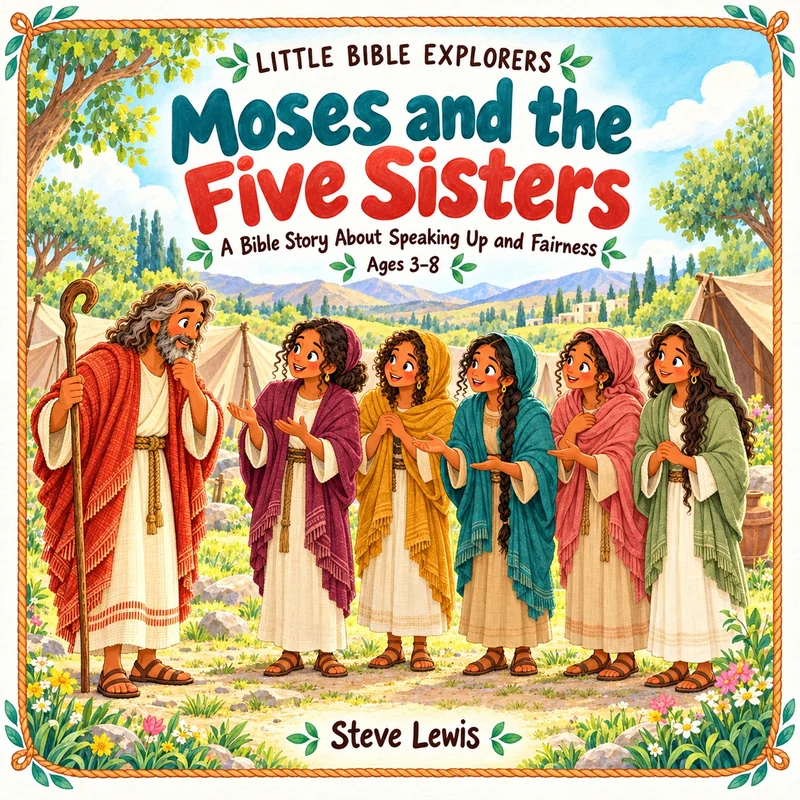
Moses and the Five Sisters is based on selected events from Numbers 27:1–11. Mahlah, Noah, Hoglah, Milcah and Tirzah ask for their family’s future share of land after their father, Zelophehad, has died. They bring their request to Moses, Eleazar the priest and the gathered people. Moses takes the case before God, who affirms their request and gives an inheritance ruling.
The book’s grown-up notes explain an important limit: the ruling applies when there is no son and does not establish equal inheritance between sons and daughters. A separate modern planting story shows Eli, Maya and Mum making room for Maya’s idea. The suggestions below are original follow-on activities rather than material copied from the book.
Ask what fairness means in everyday life
Start with a small example your child recognises: two people want the same toy, one person needs more time to put on a coat, or everybody is choosing a family game. Ask, “What would feel fair here?” Then listen before offering your own answer.
Fair does not always mean that everyone receives exactly the same thing. One child may need help while another can manage alone. You can say, “Sometimes fairness means making sure each person has what they need.” Keep the example specific, because broad questions about justice may feel too large for a young child.
Use three steps for speaking up
Practise a short sentence pattern: “I noticed…”, “I think or feel…”, and “Could we…?” For example: “I noticed I did not get a turn. I feel left out. Could I have the next turn?” A child can use only one part if the full pattern is too much.
Speaking up can also mean pointing, drawing, using a familiar sign or asking a grown-up to speak alongside them. Make clear that a child does not have to confront someone who feels frightening or unsafe.
Make a trusted-people hand
Draw around a hand and write or draw one trusted person on each finger. These might include a parent, carer, teacher or another adult the family knows well. Talk about which person the child could approach at home, at school or elsewhere.
Avoid suggesting that every adult will respond perfectly. Instead, explain that if the first person does not understand, the child can try another trusted person. A grown-up should take over when a situation is unsafe, repeated or too complicated for a child to manage.
Role-play a small, safe problem
Use toys to act out a low-stakes situation: one toy is interrupted, two toys reach for the same crayon, or one toy’s idea is ignored. Pause and ask what the toy might say or who could help. Swap roles so the child can also practise listening.
Keep the scene gentle and imaginary. Do not use role-play to make a child repeat a distressing real event. If they bring up something serious, stop the game, listen carefully and respond as the responsible adult.
Practise making room for another idea
Place two sheets of paper side by side. One person draws an idea for a garden, play space or reading corner; the other draws a different idea. Look for one part from each picture that could fit into a shared plan.
If the ideas cannot be combined, that is useful too. Talk about taking turns, choosing on different days or asking another person to help decide. The goal is not to force agreement but to show that listening can happen even when people still prefer different things.
Notice the response as well as the request
After reading or role-play, ask two questions: “How did the person speak up?” and “How did other people respond?” This keeps responsibility from resting only on the person with the concern. Fairness also depends on whether listeners make space, check facts and take appropriate action.
Praise specific actions without promising a particular result: “You explained what happened clearly,” or “You asked someone trustworthy for help.” Speaking up matters even when the answer takes time or is not the answer a child hoped for.
Keep fairness conversations open
You do not need to settle every question in one conversation. Children may return to the same event later with new details or a different view. Let them know they can talk again, and be willing to correct your own understanding when necessary.
To continue the discussion through shared reading, explore Moses and the Five Sisters. The digital edition is created for ages 3–8 and includes fourteen illustrated story scenes, seven discussion questions, a caring plan, a prayer and two activities.