All articles · · By Steve Lewis
5 Simple Listening Games for Children Aged 3–8
Listening does not have to mean sitting perfectly still or answering a quiz. Children can listen while they look, point, draw, move or ask questions. These five low-preparation games give parents and carers playful ways to notice sounds and story details together.
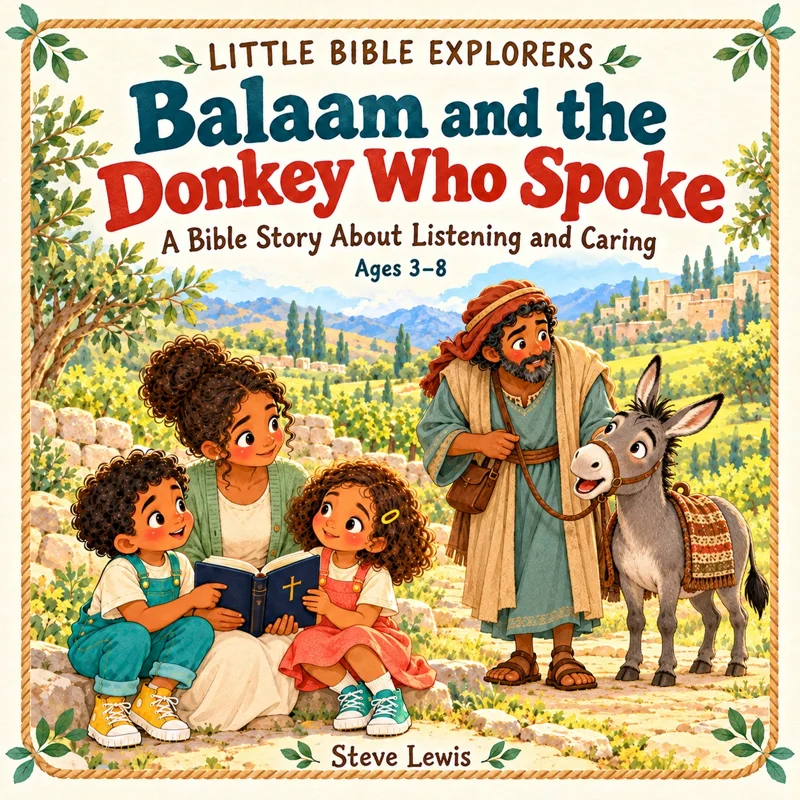
Start with a story about noticing before deciding
Balaam and the Donkey Who Spoke is based on selected events from Numbers 22:1–35. On a journey, Balaam’s donkey sees an angel before Balaam does. She turns into a field, presses against a vineyard wall and finally lies down in a narrow place. God then makes the donkey speak, and Balaam must face what he has missed and listen to the angel’s instruction.
The selected retelling names Balaam hitting the donkey three times and includes an angel carrying a sword, but hitting and injury are not pictured. The grown-up notes address the passage’s difficult details and make clear that children may question adults and seek help when something feels unsafe. The donkey speaking is an exceptional event in this Bible account; animals do not ordinarily speak in human words.
1. Play three-sound detective
Sit somewhere safe and pause for about twenty seconds. Ask everyone to notice three sounds. They might hear a clock, footsteps, birds, traffic or a page turning. Afterwards, take turns naming, pointing to or copying one sound.
There is no need to identify every noise correctly. If two people heard different things, compare where they were sitting and which sound was closest. For children aged 3–5, try just one sound; children aged 6–8 may enjoy sorting sounds into near, far, quiet or loud.
2. Draw what you heard in the story
Read a short paragraph without showing the illustration first. Invite the child to draw one thing they heard mentioned. Then look at the page together and notice what is similar or different. The drawing does not need to match the book.
This works best as an invitation rather than a memory test. A child may draw the part that interested them most, add something imagined or ask to see the picture straight away. All of those responses can lead back into the story.
3. Spot the changed detail
Say a simple sentence such as, “The blue bird sat beside the little tree.” Repeat it with one detail changed: “The red bird sat beside the little tree.” Ask what changed, then let the child create the next pair of sentences.
Keep the sentences short enough to be enjoyable. If the child does not spot the change, reveal it lightly and try again with a more obvious difference. The purpose is shared attention, not scoring points.
4. Use a pause-and-question signal
Choose a simple signal before reading: raise a hand, tap the page or hold up a question-mark card. Anyone can use it when they want the reader to pause. The person may ask a question, point out a detail or say that something is confusing.
Let adults use the signal too. This shows that careful listening includes stopping to think. It also separates listening from unquestioning obedience: children can pay attention and still ask for an explanation or help.
5. Pass the listening object
Choose a soft toy or other safe object. The person holding it says one thing they noticed in the story or during the day. Everyone else listens; then the object passes to the next person. A participant may say “pass” if they do not want a turn.
Keep contributions brief so waiting does not become frustrating. Younger children can make a sound or point to a picture instead of speaking. Finish by repeating one detail from each person to show that their contribution was heard.
Connect listening with caring
In the book’s separate modern family scenes, Maya notices tiny ants crossing a garden path. Eli, Maya and Mum pause, ask questions and make room for living things. You can try a similar observation from a safe distance: notice where a bird, insect or pet is moving without touching, chasing or blocking it.
Ask, “What did we notice when we slowed down?” Listening and observing may reveal something another person missed, but nobody notices everything. Make room for different answers and correct a mistaken guess gently.
Keep shared reading relaxed
Use one game at a time and stop while it is still enjoyable. Children do not need to sit still, remember every detail or speak aloud to take part. Looking, pointing, drawing and asking for help are all valid ways to join the conversation.
For a shared Bible story about listening, noticing and caring, explore Balaam and the Donkey Who Spoke. The 29-page digital edition for ages 3–8 includes fourteen illustrated scenes, seven discussion questions, a caring plan, a short prayer and two activities.