All articles · · By Steve Lewis
An Autumn Gratitude Walk for Children Aged 3–8
You do not need a long nature trail or a bag full of craft materials to enjoy an autumn gratitude walk. A familiar path, a garden or a view through the window can give you something to notice together. Choose one or two of the prompts below and let your child decide what catches their attention. There is no list to complete and no right thing to feel thankful for.
Choose a small, comfortable place to explore
Pick a route that suits your family, whether that is a short pavement walk, an accessible park path or a few minutes beside an open view. Check the weather and ground conditions before setting out, and take the clothing or practical support you need. You can turn back whenever you want.
Explain the idea simply: “Let’s see what we notice today.” An adult should supervise children near roads and water. Look at unfamiliar plants, berries and fungi without tasting or handling them, and leave wildlife undisturbed. Nothing needs to come home in a pocket for the activity to count.
Five things to notice, not five things to find
1. A colour: choose one colour your child likes and see where it appears. A yellow leaf, a blue door or a bright coat can all be part of the conversation. Try asking, “Where else can you see that colour?”
2. A sound: pause somewhere safe and listen. You might hear wind, footsteps, traffic or a bird. You do not need to identify the source correctly. Simply describing a sound as quiet, scratchy or far away is enough.
3. Something changing: notice a bare branch, a fallen leaf or a cloudy patch of sky. Ask, “Does this look the same as last time?” It is fine if neither of you remembers.
4. Something cared for: look for a watered planter, a swept path or a tree protected by a guard. Wonder together about the people who help look after shared places, without assuming you know who did the work.
5. Something you are glad to have noticed: this can be tiny or ordinary. Your child might choose a puddle, a bus or the warmth of their gloves. They can point instead of explaining.
Make room for feelings other than gratitude
An invitation to notice is not a demand to be cheerful. If your child is cold, tired or disappointed, acknowledge that first. You could say, “You wanted sunshine and it’s raining. Shall we head back?” You do not need to add a lesson about looking on the bright side.
Adults can offer their own observations without asking a child to copy them: “I’m glad we saw that red leaf.” A child who says nothing, chooses something different or wants to stop has still taken part in their own way.
Bring one observation into story time
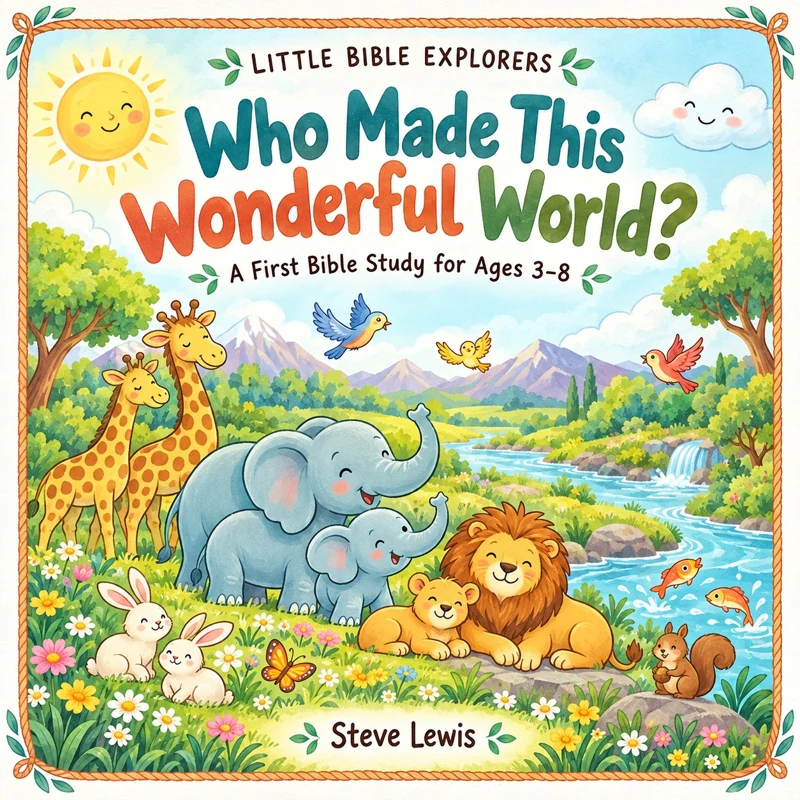
Who Made This Wonderful World? is the first Little Bible Explorers book. Its current description introduces Eli and Maya exploring light, sky, seas, plants, animals and people, with a Bible reference to Genesis 1:1–2:3. The book’s listed themes include creation, wonder, gratitude and caring for the world.
After your walk, share the digital book and look for a connection your child notices. You might ask, “Did anything we saw remind you of this picture?” Let the conversation follow the actual page rather than expecting a particular answer.
The walk described here is an additional family activity, not a reproduction of an activity inside the book. In a Christian family, you might finish with a brief prayer of thanks. Leave room for questions and for your child to listen rather than speak.
Try the same idea from a window
If going outside is not practical today, choose a view from a window or doorway. Watch a cloud, notice a colour or listen to a sound from indoors. Do not lean out or climb to get a better view.
You could draw one thing you saw, dictate a sentence to a grown-up or simply tell someone about it. A younger child may enjoy choosing between two observations. An older child might compare the same view on another day. Adapt the invitation to the individual child rather than treating age as a checklist.
Keep one small reminder, if you want to
On a piece of paper, write “Today we noticed…” and add your child’s words or drawing. There is no need to make a polished scrapbook or post a photograph online. If you keep the paper, revisit it when you next read together.
For a story-time companion about creation and gratitude, explore Who Made This Wonderful World? on its book page. You can check the current description and digital edition details there before deciding whether it suits your family.